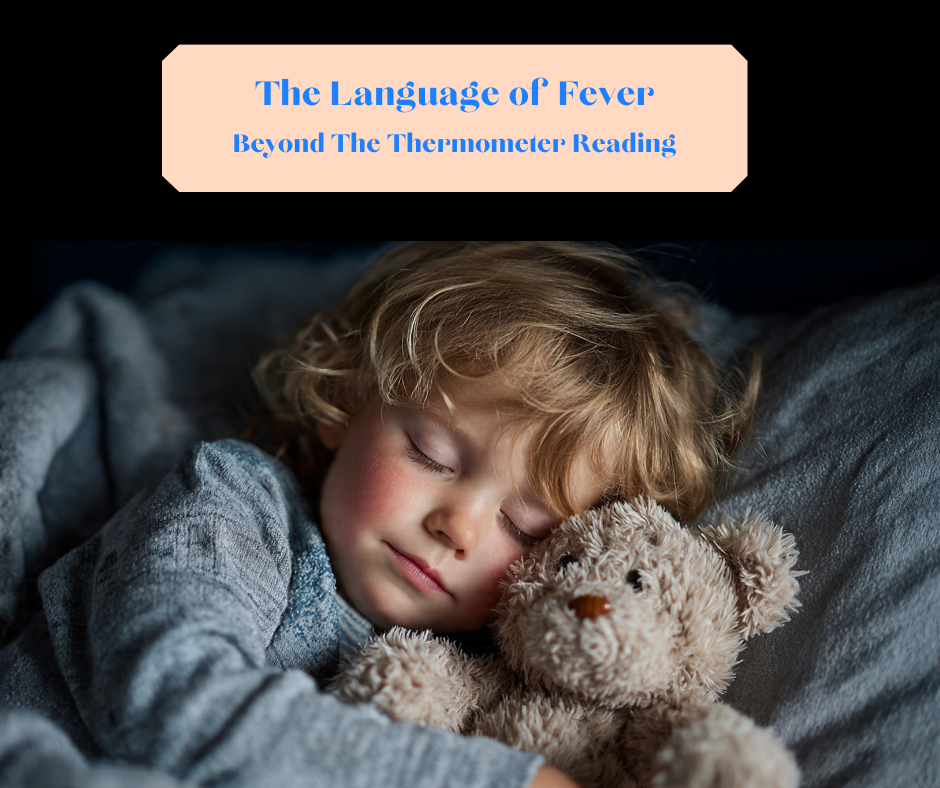
Fever itself is not the most important symptom if we only note that there is fever. There are hundreds of remedies that may potentially apply in a febrile state. What helps us choose the most appropriate remedy is observing how your child behaves and reacts during the fever.
In the great majority of cases, we can identify a number of features that qualify the fever and allow us to understand the specific way your child experiences this state.
Here is a guiding list to help you identify useful patterns and modalities.
- At what time of day or night does the fever usually start during the current episode?
- How quickly does it rise and how does it come down?
- Are there clear cycles (for example every evening, after midnight, early morning)?
- Is there a stage of chill (shivering, wanting to be covered)? In which part of the body does the chill start and how does it spread?
- Is there a stage of heat (hot skin, throwing covers off)?
- Is there a stage of sweat? which part of the body is sweating?
- What is the order of these stages? it is not always chill then heat then sweat and sometimes one is missing!
- How does each of these stages affect the child?
- Are differences in temperature of different parts of the body (eg hot head, cold hands)?
- Are there any changes in skin colour (pale, flushed, mottled, patchy redness)?
- Any tendency to one-sided symptoms (one cheek red, one hotter side)?
Then, observe your child’s modalities in a more broad manner:
- Do you notice any clear pattern of worsening or improvement (night vs day, after sleep, after eating, drinking)?
- Does the child want to be covered or uncovered?
- Is the child better with warmth or better with fresh air?
- Is the child thirsty or not thirsty?
- Does he prefer cold drinks or warm drinks?
- Does the child drink large quantities at once or small sips frequently?
- Is there increased sensitivity to light, noise, or touch?
The general disposition of the child is also a valuable cue:
- Is the child more irritable, anxious, fearful, restless, unsettled or clingy?
- Does he appear dull, slowed down, foggy, withdrawn, “not fully present”, drowsy, sleepy, hard to wake?
- Is he unusually quiet or hard to engage?
- Does he seem overwhelmed by the fever, or relatively indifferent to it?
- Is the child better with movement, or does movement make things worse?
- Does he want to lie still, curl up, or change positions often?
- Does the child seek physical closeness, being held, or does he resist touch?
- Are there any new behaviours or postures that appear only during the fever?
Don’t worry if you cannot observe everything. Fever can present in many different ways. Also keep in mind that acute situations may evolve quickly, and a remedy that helped for a day or two may need to be replaced as the state changes.